
en

02.11.2026
|
Katarzyna Gapińska
A compliance matrix for the EU Pay Transparency Directive: every requirement mapped to a concrete Levelly.ai feature, plus answers to the questions HR teams ask most.
Pay transparency
Compliance
Labour law
HR
Written by

Katarzyna Gapińska
Co-founder of Levelly.ai
Table of contents
“Directive-compliant reports” is now a standard claim on every vendor’s website. The problem is that the claim alone proves nothing. Directive 2023/970 imposes more than a dozen separate, very specific obligations. Only by mapping each of them to a tool’s actual features can you see whether a product will carry a company through the compliance process or simply calculate a single number.
Below we map every requirement of the directive to a concrete feature of the Levelly.ai platform. At the end, we answer the questions HR teams ask most often during conversations and demos.
Directive (EU) 2023/970 of the European Parliament and of the Council on pay transparency was adopted on 10 May 2023. Member States were required to transpose it into national law by 7 June 2026. In Poland, work on the implementing act is underway.
The obligation to report the pay gap periodically depends on the size of the organisation:
The directive is not only about reports, however. It introduces pay-range transparency as early as the recruitment stage and bans asking candidates about their previous pay. It gives employees the right to information on average pay and removes confidentiality clauses on pay. The employer bears the burden of proof. And when the gap reaches 5%, it triggers a joint pay assessment.
Status legend: Available — the feature works in the platform. To confirm in a demo — scope depends on data and configuration; we show it live. Process support — the tool provides data and a signal, while the decision and the process remain with the organisation.
A methodological note: the part of the gap a model treats as “explained” does not automatically become legally justified, and the “unexplained” part is not automatically proof of discrimination. The tool points to areas for analysis. The justification and the decision are made by the organisation.
The obligation to report the gap periodically starts at 100 employees. The other rights, however, apply to every employer regardless of size: pay-range transparency in recruitment, the ban on asking about pay history, the employee’s right to information on average pay, and the ban on confidentiality clauses.
The deadline to transpose the directive into national law passed on 7 June 2026. In Poland, work on the act is underway. The first reports for the largest companies fall on 7 June 2027, so now is the time to prepare data and processes. Collecting and organising pay data usually takes longer than expected.
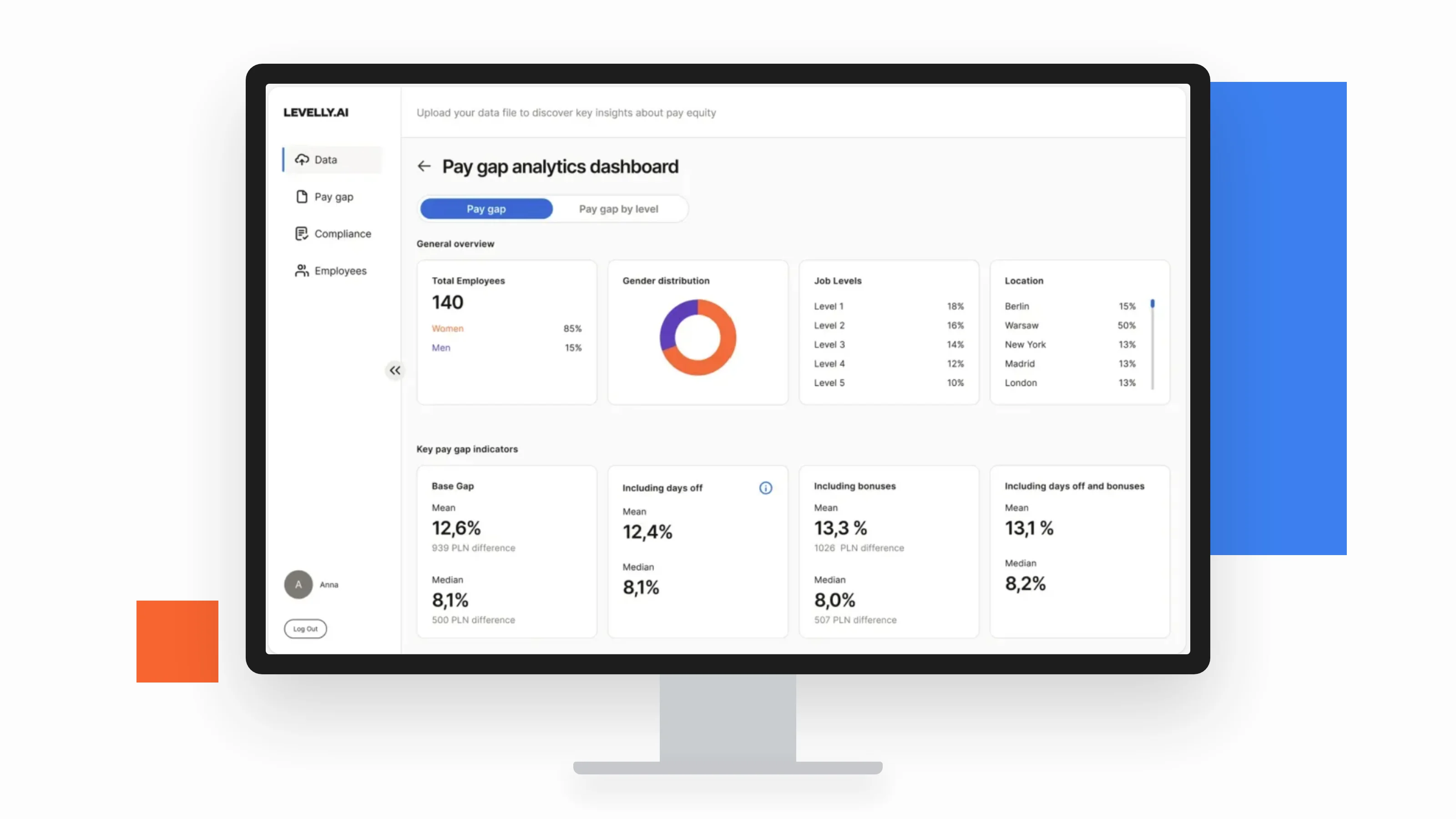
The raw (unadjusted) gap is the simple difference between the mean or median pay of women and men. It is the basis for reporting. The adjusted gap accounts for factors such as job level, tenure or working time and shows how much of the difference remains unexplained. For the report, you need the raw gap; the adjusted gap helps you understand the causes and defend against a discrimination claim.
Work of equal value is work that differs in job title but is comparable in required skills, effort, responsibility and working conditions. The directive requires comparing pay precisely within these categories, set by objective, gender-neutral criteria. In Levelly.ai, levels L1–L5 are the starting point. In a demo, we show how to map your job structure to categories and how to document the criteria.
If reporting shows a gap of at least 5% in a category of workers that cannot be justified by objective, gender-neutral criteria and is not remedied within 6 months, the employer must carry out a joint pay assessment with worker representatives. The platform flags threshold breaches at various levels and provides data for that assessment.
The directive does not require mechanically equalising all differences. It requires that differences be justified by objective criteria or removed. You may not, however, lower pay to “close” the gap. Levelly.ai helps identify which differences require action and how much a correction would cost before you decide.
The employer. In a pay discrimination claim, the company must show that the difference results from objective, gender-neutral factors. That is why documentation matters so much: report history, justifications of differences and a trail of actions taken. The platform stores and monitors all of it.
This is the most important and entirely fair question. That is why we show not only the result but also the method: which variables enter the model, when we apply the Oaxaca–Blinder decomposition, how we treat bonuses, part-time work and small groups, and how the explained part differs from the unexplained one. It is best to verify this on your own or anonymised data during a demo.
This is a frequent and legitimate question from HR and security teams. We discuss the details — data location, the data processing agreement (DPA), encryption, access control and retention period — individually, to meet your internal requirements. The platform processes HR and payroll data securely.
The starting point is a CSV or Excel file. The platform guides you through uploading the data and detects errors before the analysis, so you don’t need an IT department or spreadsheets. The metrics appear right after validation. The scope of data preparation depends on how well your pay data is organised, and we discuss it during a demo.
Yes. The directive sets a common minimum, but details such as thresholds, deadlines and penalties differ by country. Levelly.ai generates country-tailored reports, and the plan for larger organisations covers multiple entities (parent companies together with subsidiaries).
Marketing claims look similar across every vendor. The result on your data does not. In 30 minutes, we’ll show how the platform calculates the raw and adjusted gap, identifies risk groups and documents a decision on data close to yours. You’ll leave the meeting with a ready checklist of compliance points to tick off — not another slide.
See your compliance matrix live — book a 30-minute demo.
Prefer to explore the tool yourself first? Start for free, no card required.
Informational material. Not legal advice. The scope of compliance in a specific case depends on the final shape of the national act implementing Directive 2023/970 and on the organisation’s data and configuration. The “to confirm in a demo” statuses indicate features whose exact scope we show live.
Turning compensation data into clear, actionable pay equity insights — so you can ensure fair pay, stay compliant with EU Pay Transparency Directive, and build a more equitable workplace

Join us on LinkedIn

The “Levelly.ai” project has received funding from the European Funds under the Startup Booster for Social Impact program, implemented by the Polish Agency for Enterprise Development (PARP) in cooperation with SWPS University. The Levelly.ai platform enables companies to independently analyze and monitor the gender pay gap and identify its root causes. It is designed for organizations that want to operate in line with EU regulations and their internal values. The platform will be available in Poland and internationally. Total project value: PLN 198,758.95
The project is implemented under the European Funds for a Modern Economy 2021–2027 (FENG) program, Priority II, based on grant agreement no. FENG.02.28-IP.02-0003/23-00.
The company Levelly.ai PSA has received funding from European Funds under the Startup Spark 3.0 Acceleration Programme, implemented by the Łódź Special Economic Zone. The total project value is 200,000.00 PLN. The project is carried out under the European Funds for the Modern Economy programme, Priority II: An Environment Fostering Innovation, Action: Startup Booster Poland – Smart Up.
