
en

15.09.2026
|
Katarzyna Gapińska
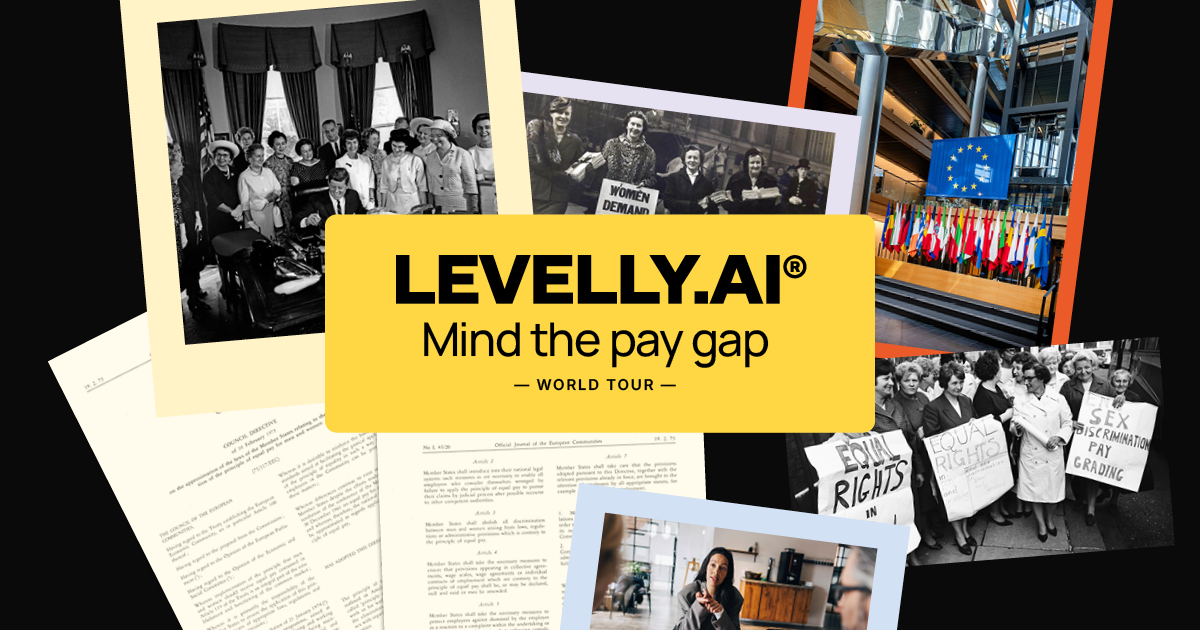
Our setlist isn't just decoration on a T-shirt. It's sixty years of lawthat slowly learned to see more and more — and five acts that changed the rulesof pay. Here's the tour. And the next stop is your company.
Compliance
Compensation management
Pay fairness
Pay gap
Pay transparency
Total rewards
Labour law
HR
Written by

Katarzyna Gapińska
Co-founder of Levelly.ai
Table of contents
When the EU Pay Transparency Directive comes intoforce in 2026, the pay gap will start shouting in every company. We decided toshout first — and to tell this story the way we see it: as a concert tour. Fiveacts, sixty years, one direction. Because the road to equal pay wasn't a single pieceof legislation. It was a series of breakthroughs, each of which widened who thelaw could see at all — and each time it was driven forward by specific peopleand events, not by governments acting on their own initiative. That's animportant context for companies: these changes never waited for a convenientpolitical moment. They won't wait now either.
Act I — United States, 1963. The first federal equal pay law banned pay differences for "substantially the same work". It was a breakthrough, yet one that saw only a single axis — sex — and only within the same establishment. It couldn't recognise women discriminated against for several reasons at once.
Act II — United Kingdom, 1970. The law was forced from below by a strike of 187 machinists at a Ford factory. But even equalising pay for the same work didn't close the gap — because its quiet engine turned out to be motherhood.
Act III — European Union, 1975. The leap from "the same work" to "work of equal value". This struck at the heart of the gap: the systemic undervaluation of occupations dominated by women.
Act IV — European Union, 2006. The quietest breakthrough: the burden of proof shifts to the employer. The law stops requiring proof of ill intent and starts catching hidden and systemic discrimination — including on the grounds of age or disability.
Act V — European Union, 2023. Transparency as a tool. The light that exposes every pay difference that can't be justified — and marks the tour's next stop: 2027, your company.
Because the 2023 directive turns this story from ahistory lesson into a task for tomorrow. In the articles that follow, we setout each act separately — with data and research that no poster could hold —and at the end we show what sixty years of law means, in concrete terms, foryour company today. Buckle up. No closing date. Find out your gap before anyone else does. Get your free e-ticket and join the Mindthe Pay Gap tour.
Turning compensation data into clear, actionable pay equity insights — so you can ensure fair pay, stay compliant with EU Pay Transparency Directive, and build a more equitable workplace

Join us on LinkedIn

The “Levelly.ai” project has received funding from the European Funds under the Startup Booster for Social Impact program, implemented by the Polish Agency for Enterprise Development (PARP) in cooperation with SWPS University. The Levelly.ai platform enables companies to independently analyze and monitor the gender pay gap and identify its root causes. It is designed for organizations that want to operate in line with EU regulations and their internal values. The platform will be available in Poland and internationally. Total project value: PLN 198,758.95
The project is implemented under the European Funds for a Modern Economy 2021–2027 (FENG) program, Priority II, based on grant agreement no. FENG.02.28-IP.02-0003/23-00.
The company Levelly.ai PSA has received funding from European Funds under the Startup Spark 3.0 Acceleration Programme, implemented by the Łódź Special Economic Zone. The total project value is 200,000.00 PLN. The project is carried out under the European Funds for the Modern Economy programme, Priority II: An Environment Fostering Innovation, Action: Startup Booster Poland – Smart Up.
